

Selecting the appropriate waterproofing system to use on a commercial roof is not just a matter of materials but rather a matter of performance when time goes by particularly in a climate like that of Melbourne. When you are asking about SBS vs APP modified bitumen, then you are asking the right question. The two systems are common in Australia, both comply with building standards and both can produce long-term results when properly installed.
Call 0414 060 534 for a free phone consultation with our Liquid & Torch-On Membrane.
However, they act in a different manner. And these are important when you are planning or designing a roof which must withstand cold winters, high UV exposure, and continuous shifts in temperature.
This guide disaggregates the functionality of APP torch on membrane and SBS systems, where each of them performs best, and what is actually the best practice in Melbourne conditions.
What Is the Difference between SBS and APP Modified Bitumen?
On a fundamental level, both SBS and APP are forms of modified bitumen waterproofing, that is, traditional bitumen is added with polymers so that its performance can be improved.
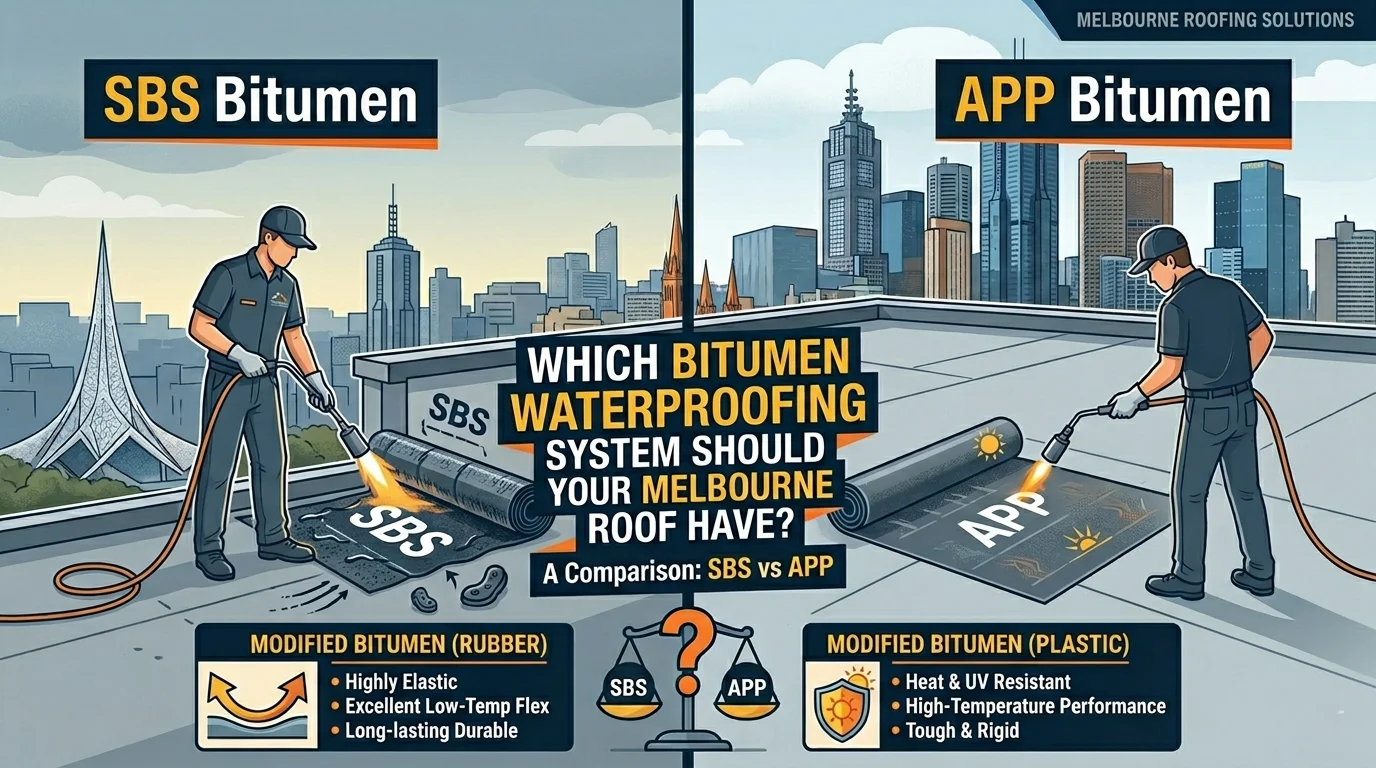
SBS or Styrene Butadiene Styrene is a rubber reinforced membrane. It is made to be flexible and is therefore appropriate in managing the movement within the building structure. This can be of particular importance in colder weather, when materials shrink.
APP is a plastic-modified one, Atty Polypropylene. In lieu of flexibility, it is concerned with durability and heat and UV resistance. It retains its shape effectively at high temperatures and also it is not highly influenced by direct sunlight.
In easy terms, therefore, SBS is more like rubber and APP is more like plastic. It is the difference that makes them perform in real-life situations.
What is the best Bitumen in the Melbourne climate?
The climate of Melbourne is considered variable. Mornings are cold, afternoons are warm and weather changes cause expansion and contraction on roof surfaces all the time. It is there that temperature cycling of flexible roof membranes takes a central stage.
SBS is a material that works a little better in colder seasons since it is a flexible material that can take in movement without cracking. This is especially applicable in regions where there is structural movement likely or where cold weather performance is of concern.
Conversely, APP is at an advantage in hot seasons. Its composition gives it a high level of bitumen membrane UV resistant and therefore it can withstand extended exposure to sunlight without degrading as fast.
It is due to this reason that a combination system is regarded by many professionals as the most suitable waterproofing membrane in Melbourne climate. A balanced system can be achieved with an SBS base layer providing flexibility and an APP cap sheet that provides protection against UV and works well all year round.
What is the Life Expectancy of SBS and APP Roof Systems?
Lifespan is among the most widely used factors when deciding on the modified bitumen waterproofing types. Both SBS and APP are long-term, but their operation is determined by the quality of installation and service.
A SBS system has a normal lifespan of twenty to twenty five years under the Melbourne weather conditions. In regions that are in the direct sunlight, that lifespan can decrease slightly without the necessary UV protection.
The lifespan of the APP systems is usually long, up to thirty years. This is mostly because they are more resistant to UV rays which retard degradation of surfaces with time.
In both cases, regular maintenance plays a critical role. Even the most competent membrane will not last long in case of drainage problems, debris accumulation, or small damage.
Price Dissimilarity Between SBS and APP Membranes
As far as prices are concerned, the gap between SBS and APP is not as big as some might think. There is a general proximity between material costs, with a slight difference between the two.
The point of difference in costs is in installation. APP membranes may demand more accurate use of the torch, and due to the higher cost of labor, it may be slightly higher. But in the majority of commercial projects the total difference is not very big.
This implies that the choice cannot be made on the basis of price alone. Rather, it ought to be performance, lifetime, and the suitability of the system to your project.
Is it Possible to Integrate SBS and APP on the same roof?
Yes–and, in most instances, that is the course to be followed.
Dual layer, where the base layer is an SBS and the top layer is an APP, is the best practice in commercial roofs. This mix exploits both materials: the flexibility of SBS and the APP durability and resistance to UV.
Although this method might add some added cost to the initial cost, it can be more valuable in the long-run. The additional safety minimizes the chances of premature collapse and is able to increase the total life of the waterproofing system.
Is it possible to install APP over an existing SBS Roof?
This is the question that is frequently asked during the refurbishment projects. In most instances, it is possible to overlay APP on an existing SBS system, provided, however, that the underlying membrane remains in a good condition.
When the SBS layer is dry, bonded, and has no structural problems or moisture they may be used as a stable base. Nonetheless, in case of delamination or water damage indications, the current system will have to be removed prior to the installation of a new membrane.
Before making this decision, a comprehensive check is obligatory because the installation over a failed surface may result in an early breakdown.
Is Installation Quality More Important Than the Material?
Absolutely. The worst thing is that even the best torch applied membrane Melbourne climate system will not work when it is poorly installed.
Seam integrity, proper torching, substrate preparation and detailing around penetration are significant contributors of performance. Actually, installation problems are the leading causes of waterproofing malfunction as opposed to material flaws.
This is the reason I must cooperate. Experienced contractors. It is craftsmanship that can be created. The difference between a roof He lives a lifetime And one It is not so.
Do SBS and APP Meet Australian Standards?
SBS and APP membranes can be used in installations that satisfy building requirements in Australia. They adhere to policies like AS 3740 and AS 4654, and the National Construction Code.
Both of these are technically applicable in the commercial sphere. It all depends on the right choice of the system to be used in your conditions of the building and the right choice of the system ought to be installed to a high standard.
What is The Frequency of Inspection of a Bitumen Roof?
Maintenance is not an aspect that is taken into consideration; but holds significant importance in increasing the life of any waterproofing system.
At a minimum, roofs should be inspected once a year. Older systems especially those that have passed the mid life of their use should be checked more often. Another thing I recommend to check after a significant weather event is the roof, which is not always apparent whether it has been damaged.
Repetitive checks are also important in any long-term maintenance plan as they allow finding minor problems before they translate into expensive repairs.
SBS versus APP: Which one to Select in Your Project?
Whether the roof will be SBS or APP should depend on the performance of roofs in the long run rather than the cost or preference of the roofs.
SBS is a good option in case your project needs to be flexible and move freely. In case UV exposure and heat resistance are primary issues, APP has obvious benefits.
Nevertheless, in the majority of commercial buildings in Melbourne, neither option would be the best solution, it is a combination of both. The reason why a dual- layer system is more efficient than a single- layer system That’s because a dual- layer system is more balanced. Its reaction To temperature variations, UV exposure, and structural movement.
Conclusion:
Comparing APP torch on membrane to SBS, it is obvious that the materials have their strong points. SBS is flexible and has good cold performance whereas APP is strong and has better UV resistance.
However, the most important lesson is as follows: most effective roofs in Melbourne are never constructed using a single system. The integration of SBS and APP makes the waterproofing solution more robust to meet the challenging environment of the city.
When the day is over, choice of materials counts, however, the quality of installations, appropriate design, and maintenance counts even higher.
Whether you have a new project or want to upgrade your current roof, when you hire the services of reputable people such as Complete Construction Service, it will make sure that your waterproofing system is not only specified properly but constructed in a manner that will provide long-term service.