

Looking for a solution regarding Liquid & Torch-On Membrane? Selecting the appropriate waterproofing system does not only represent a technical option- it is the issue that directly affects the durability of your bathroom. A lot of homeowners will just begin to look into options when the leaks or damage have been noticed, however, by this point, the wrong decision can already be costing thousands of dollars.
Call 0414 060 534 for a free phone consultation with our Liquid & Torch-On Membrane.
When you are comparing liquid membrane and torch-on waterproofing or whether a DIY waterproofing would save you some money, you are already thinking like a smart decision-maker. Now, let we pass through what really works in Melbourne and what usually does not.
Why Waterproofing Choice is such a big issue in Melbourne.
The climate of Melbourne is one of the largest causes why waterproofing systems fail sooner than projected. Houses in this region experience the continuous change in temperatures, such as hot summer, and cold winters. That periodic enlargement and narrowing imposes strain on the surfaces of the bathroom, notably the joints and corners.
To this add the daily exposure to moisture, steam, and humidity, and your bathroom is one of the most challenging places in the house. This is why the selection of the right system is not only based on the cost, it is based on long-term performance.
It is also necessary to learn that bathroom waterproofing in Australia should comply with AS 3740 requirements. Not all products or techniques that you find online can fulfill this need, and that is what most DIY solutions lack.
Learning the Three Major Waterproofing Choices
When the majority of the population begins research, they encounter three popular ones: liquid membrane systems, torch-on membranes, and DIY sealers. They may appear to be the same on the surface, but in real life, they do not work in the same way.
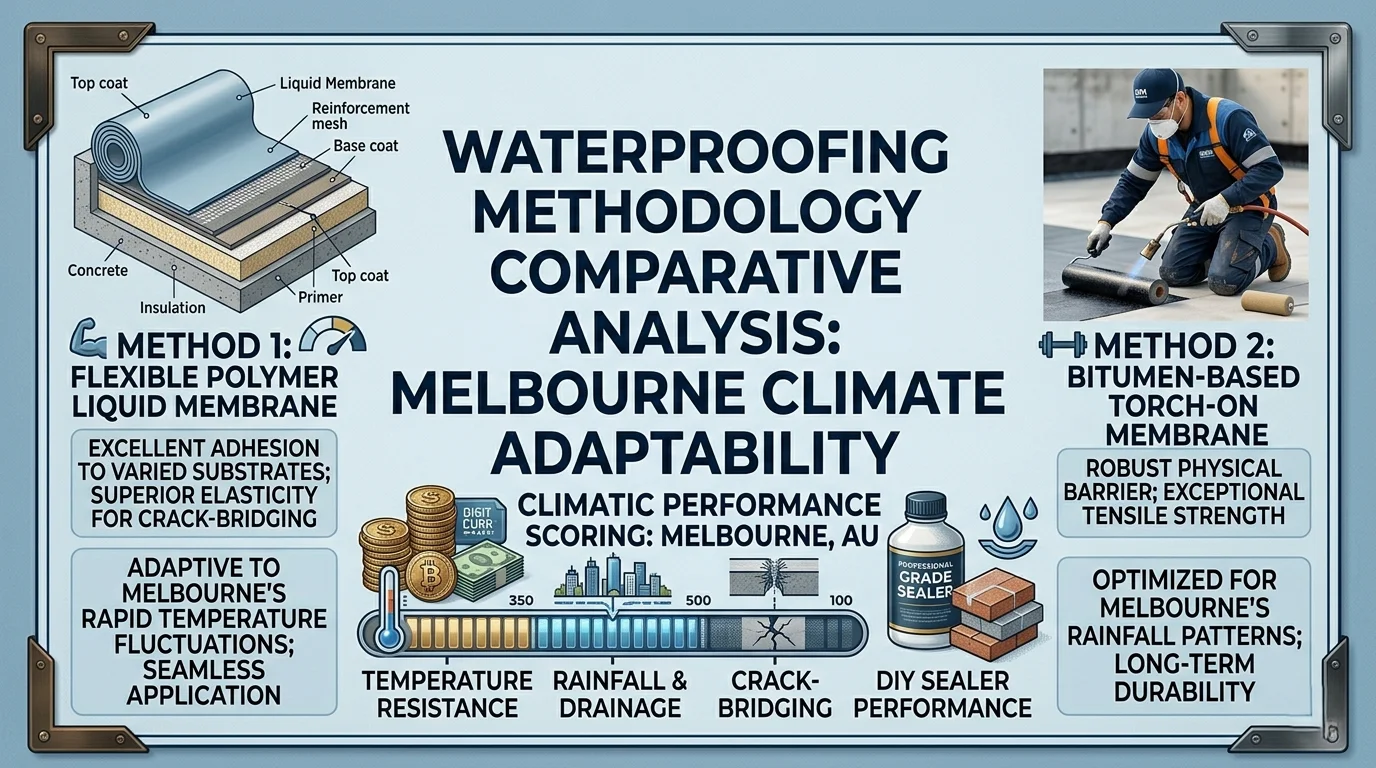
Liquid Membrane Waterproofing: The Trade Standard.
The most commonly used waterproofing method used by professionals today and with good reason is liquid membrane. Liquid coating is sprayed on the surfaces of the bathrooms instead of laying sheets. After curing it creates a waterproof barrier that is smooth and flexible so that no water can penetrate under tiles.
The flexibility of this system is what makes it especially efficient in Melbourne. Buildings move naturally with time and temperature changes do not help in reducing this movement. A liquid membrane is able to withstand that pressure without cracking or fracturing.
The other major benefit is that it does not have seams. There are no joints between the sheets, so there are fewer weak areas where the water can creep. This is particularly necessary at such places as shower corners, shower drains, and wall-floor junctions.
Most homeowners should pay between 1,800 and 4,500 dollars depending on the size and state of the bathroom. Although it can be a substantial initial expense, it can help to save a lot of money on repairs in the future.
Generally, liquid membrane waterproofing is generally regarded as the best choice, in case you are in need of a durable and quality solution that meets the Australian standards.
Torch-On Waterproofing: Tough but No-Bathroom.
Torch-on waterproofing has many misconceptions. It is an extremely strong system, which is used more on the outside such as on roofs rather than on the inside as a bathroom floor.
This technique entails using a gas torch to heat sheets made of bitumen to stick them to surfaces. That is fine in open, outdoor settings but is extremely constraining when it comes to indoors. It is also not very practical and is a safety risk to use open flame in a bathroom.
In addition to the safety issues, torch-on membranes do not fit narrow and intricate areas such as bathrooms very well. Corners, edges, and plumbing penetrations need accuracy, and sheet-based systems have problems adjusting to those complications.
Torch-on waterproofing therefore has a role in construction but bathrooms are not one of them. Most of the times, it is not advisable.
Home DIY Waterproofing Sealers: Inexpensive and Dangerous
The popularity of DIY waterproofing products is due to their claimed fast outcomes and low price. They are available in the hardware store where you can pick them up, apply them on your own, and feel that you have solved the problem.
However, the truth of the matter is otherwise
A majority of DIY sealers form a thin layer. They do not offer the richness, versatility or endurance to protect over a long period of time. What is more important is that they do not normally comply with the AS 3740 and, therefore, are not appropriate in case of bathroom waterproofing.
They may appear effective in the short-run. But with the course of time, water penetrates through tiny orifices, cracks or weak points. When the first signs are seen, the damage beneath may be far-reaching.
What begins as a cheap fix may soon escalate into a cost of repairing of up to $5,000 to 15,000 or more, particularly when structural components are involved.
The reason why Liquid Membrane is better than the alternatives.
It is understandable why professionals always prefer liquid membrane systems when it comes to other systems. It is all a question of reliability.
Liquid membrane technology does not use joins or overlaps, unlike sheet-based systems, which are frequent points of failure. Rather, they create a continuous wall that is also bonded to the surface.
They are also more aligned to movement. That flexibility is very important in the duration of the waterproofing in a climate such as Melbourne where expansion and contraction are a constant.
Lastly, the liquid systems are simpler to inspect and certify. It is not only necessary to comply, but also to have peace of mind. When the job is done correctly then you know that your bathroom is secure.
Can You Realistically Save Money with cheaper Waterproofing?
It is human to seek cost cutting methods, particularly in renovations. However, in one area, cutting corners can always backfire, waterproofing.
A lower cost approach would be less expensive initially, but it tends to have less life and a greater chance of failure. The repair expenses soon become more than the original savings as soon as the water begins to leak.
Homeowners are caught in the middle paying once in the cheaper solution, and a second time when they have to do the right repairs.
What Can Go Wrong When Waterproofing?
Waterproofing failures do not necessarily manifest themselves at the moment. Actually, the most terrible harm occurs behind the scenes.
Water may creep under tiles, and in walls, and under floors, without any apparent evidence at first. In the long run this causes complications such as moulds, decaying wood and structural components.
Even the slightest errors during the installation process, e.g., the wrong surface preparation, or even the use of the membrane that is too thin can ruin the entire system. This is why good workmanship is of the same importance as the material.
The Real Difference between Waterproofing DIY and Professional?
On the surface, the distinction between DIY and professional waterproofing may appear to be a price or convenience issue. However, in actuality, it is far beyond that. It is not only the quality that is the biggest difference, but the accountability and long-term reliability.
In selecting a DIY solution, you are basically putting your faith in a product to perform a task that is typically the work of technical expertise and experience. These products can be claiming fast results, yet they are not often tested in the conditions of reality and in the long-term. It is not certified with compliance to be met, no formal documentation, and no guarantee that can be reverted to in case anything in the event of a hitch.
Professional waterproofing, in its turn, adds order and confidence to the process. An installer who is licensed will act under the Australian standards, give correct documentation and make sure that the work is within the compliance requirements. More to the point, they are privy to the technical details, such as surface preparation, thickness of the membrane, and sealing of sensitive points, which the majority of DIY methods cannot possibly mimic.
This difference is extremely significant to homeowners who are planning to sell their houses, do renovation, or simply do not want to spend money on repairs in the future which they may not have foreseen.
FAQs:
Is it possible to use torch-on waterproofing in my bathroom?
No, torch-on systems fall under open flame and this is why they cannot be applied in small, and enclosed rooms like bathrooms. A liquid membrane system is a lot safer and complaint system.
What do I do to know whether my waterproofing is AS three seven four zero or not?
When the job is done, a licensed professional is expected to issue you with a compliance certificate. In case this document is not provided it is a good indication that the work might fall short of the expected standards.
Is Liquid membrane waterproofing toxic?
The majority of the current liquid membrane products are low in volatile compounds and are not harmful when used properly. Water-based alternatives are even more environmentally clean and less harmful to the indoor use.
Are there any waterproofing options that can be done during winter in Melbourne?
Yes, it can be done during winter. Nevertheless, the lower temperatures are likely to delay the curing process. Seasoned experts manipulate the schedule and procedures to make sure that the waterproofing will be in place.
Is the selection of waterproofing influenced by the type of tile?
No, the waterproofing layer is under the tiles. The choice is based on the structure and surface below, and not the kind of tile that you prefer.
Conclusion: Liquid & Torch-On Membrane
Not every technique gives equal results with regard to bathroom waterproofing. Although torch-on systems and DIY sealers might appear attractive in some circumstances, they just cannot offer the amount of reliability required in the internal spaces of the bathroom, particularly in such a climate as Melbourne.
The most reliable one is liquid membrane waterproofing. It is durable, flexible and compliant with the Australian standards. More to the point, it safeguards your house not only today, but in the far future as well.
Seek the Right Advice of Experts Regarding Liquid Membrane
Selecting a suitable waterproofing system may be rather stressful, not to mention that there are a lot of different systems. However, by making the correct choice at the very beginning, you will save a lot of time, money and stress in the future.
Complete Construction Service assists the homeowners in Melbourne to make informed choices without any hesitations as it makes sure that the correct approach is chosen, all the work is done according to Australian standards, and the performance in the long-term is not compromised.
Elaborate Before You Decide for Liquid Membrane
In case, you are not certain about what kind of waterproofing solution is most appropriate in your bathroom, it is always better to consult before proceeding.
Arrange a meeting with Complete Construction Service and ensure that your investment is safeguarded properly at the stage of its beginning.