

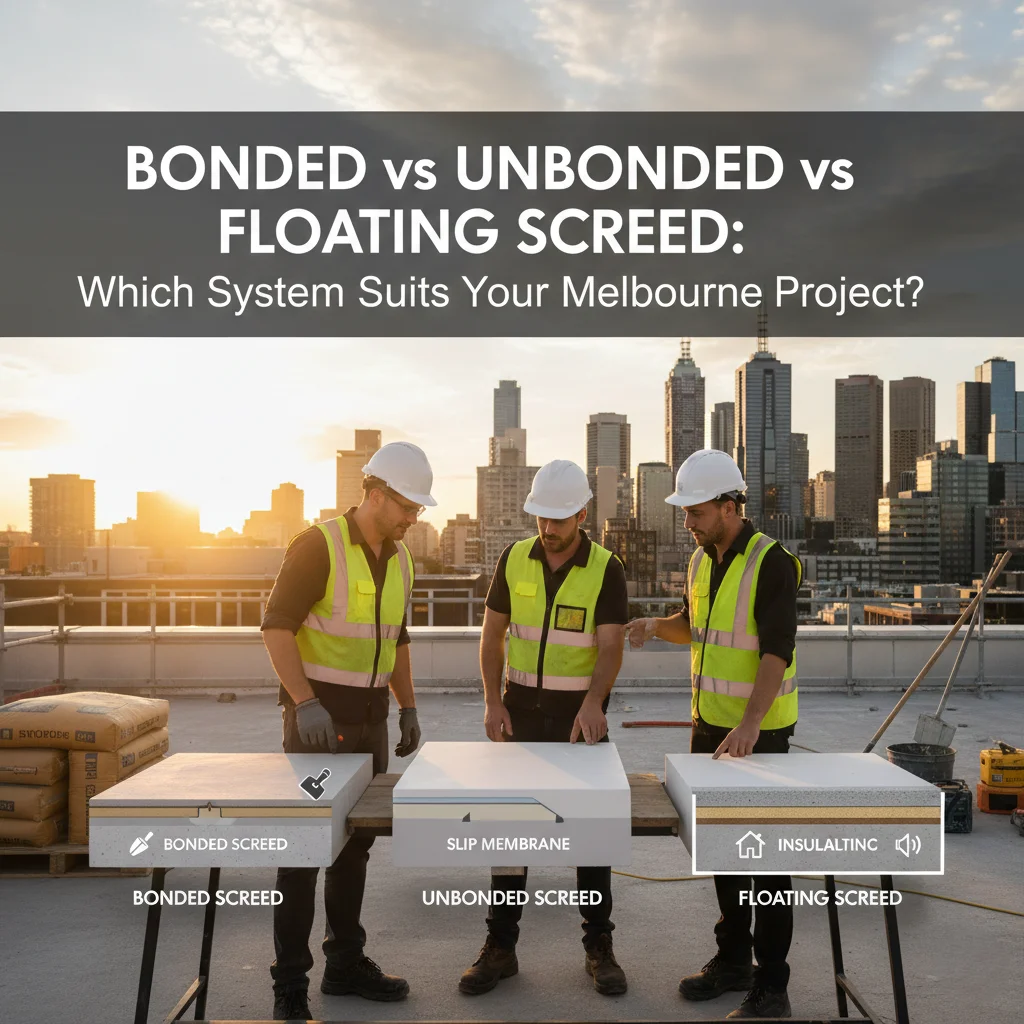
Bonded vs Unbonded vs Floating Screed: Which System Suits Your Melbourne Project?
Bonded Screed vs Unbonded vs Floating Screed? The selection of which screed system to use is among the most critical decisions in any flooring project. Melbourne has an extensive range of renovations, range of temperatures and substrate conditions, so choosing an incorrect type of screed may result in cracking, debonding, moisture failure, or expensive rework.
Call 0414 060 534 for a free phone consultation with our Screeding Expert In Melbourne.
This manual describes the bonded, unbonded and floating screed systems, the differences between them and which system best suits your Melbourne project, be it as a renovation, under floor heating installation, or a new building.
Knowledge of Floor Screed Systems Melbourne
Floor screed refers to a layer of cementitious material which has been laid over a structural slab in order to:
- Make the surface smooth and flat
- Improve load distribution
- Lay tile floors, timber floors, or bear carpet floors
The most prevalent types of floor screeds systems in Victoria include:
- Bonded screed
- Unbonded screed
- Floating screed
Each of the systems is intended to be used with a different purpose and is used differently under different conditions on the site.
Bonded Screed Melbourne: Optimal when Strength matters
What Is Bonded Screed?
Bonded screeding is applied over an existing prepared concrete base with bonding slurry cement area or epoxy primer. The screed gets attached structurally to the slab underlying it.
- Typical Thickness
- 20-40mm
- When Bonded Screed Is Used
- Limited floor height renovations
- Residential or commercial high traffic places
- Projects that needed high load transfer
- Where the floor level has to be held down
Advantages of Bonded Screed:
- Good structural integrity
- Thinner application can be made
- Loss of movement and flexion
- Perfect Melbourne renovations
- Risks In case of improper installation
- Loss of bondage through bad surface preparation
- Breaking whether substrate is not clean or sound
Moisture-related failures
Projects of bonded screed Melbourne require professional preparation of the substrate, i.e. cleaning, priming, and grinding are indisputable.
Moisture and Movement Control Unbonded Screed Applications
What Is Unbonded Screed?
Unbonded screed is poured onto a segregating membrane like plastic covering or a damp-proof membrane (DPM). The screed is not attached to the slab of concrete.
- Typical Thickness
- 50-70mm
- Good Applications of Unbonded Screed
- Moisture issues with slabs
- Concrete cracking in old age
- Projects that require moisture insulation
- Mixed use flooring substrates
Benefits
Minimizes exposure of moisture
Allows minor movement between slab and screed
Appropriate to Victorian houses whose slabs are becoming old.
- Limitations
- Requires greater thickness
- Increased material cost
- Criminal detailing may result in curling or cracking
The main differences between Floating and Bonded Screed
What Is Floating Screed?
A floating screed is laid on an insulation layer or acoustic layers and is not connected to the structural slab in any manner.
- Typical Thickness
- 65-75mm (or more)
- Ideal Applications
- Underfloor heating systems
- Apartments that have to be soundproofed
- Melbourne homes that are eco friendly
- Multi-storey buildings
Advantages:
- Superior thermal and acoustic characteristics
- Companies with underfloor heating
- Stops screeds due to slab movement
Drawbacks:
- Increased floor height required
- More complicated installation
- Wrong thickness results in cracking
What is the best Screed System to use in Home renovations in Melbourne?
In the majority of renovation projects:
The choice would be Bonded screed Melbourne because:
- Low floor build-up
- Cost efficiency
- Structural reliability
However:
- Select unbonded screed when there is a presence of moisture
- Select underfloor heating or acoustic screed floating
- Possible Dangers of Selecting an inappropriate Screed System
The choice of an inappropriate system may lead to:
- Cracking and delamination
- Moisture failure
- Uneven floors
- Poor performance of floor finishes
- Thousands of rectification costs
This is the reason why prior to screed installation professional assessment is essential.
Complete Construction Service Professional Advice
The screed selection at Complete Construction Service would be determined by:
- Substrate condition
- Moisture levels
- Load requirements
- Floor height constraints
- Melbourne climate factors
Our team concentrates on all the screed installation techniques in Melbourne, and this guarantees the long-term performance and not short-term outcomes.
Bonds, Unbonds and Floating Screeds: Frequently Asked Questions.
What is the most effective screeding system to be used in the home renovations in Melbourne?
Bonded screed tends to be the best one because it is less thick and strong.
Would all three screed types be compatible with underfloor heating?
Floating screed systems are compatible with underfloor heating.
What is the required thickness of each type of screed system?
- Bonded: 20-40mm
- Unbonded: 50-70mm
- Floating: 65-75mm+
What do I know about the screed system that my project in Melbourne requires?
It needs to be evaluated professionally in terms of substrate, moisture, and usage.
What are the dangers of having the wrong screed system?
Cracking, moisture failure, movement of the floor and expensive remedies.
Final Thoughts
In the process of executing an effective flooring process, the difference between bonded, unbonded and floating screeds should be known. In the majority of renovations, solutions of bonded screed Melbourne provide the optimal combination of strength, price, and performance, however, each project is different.
Call 0414 060 534 for a free phone consultation with our Screeding Expert In Melbourne.
To have a professional design and a sustainable outcome, leave the design of an appropriate screed system of your Australian property in the hands of Complete Construction Service in Melbourne.