

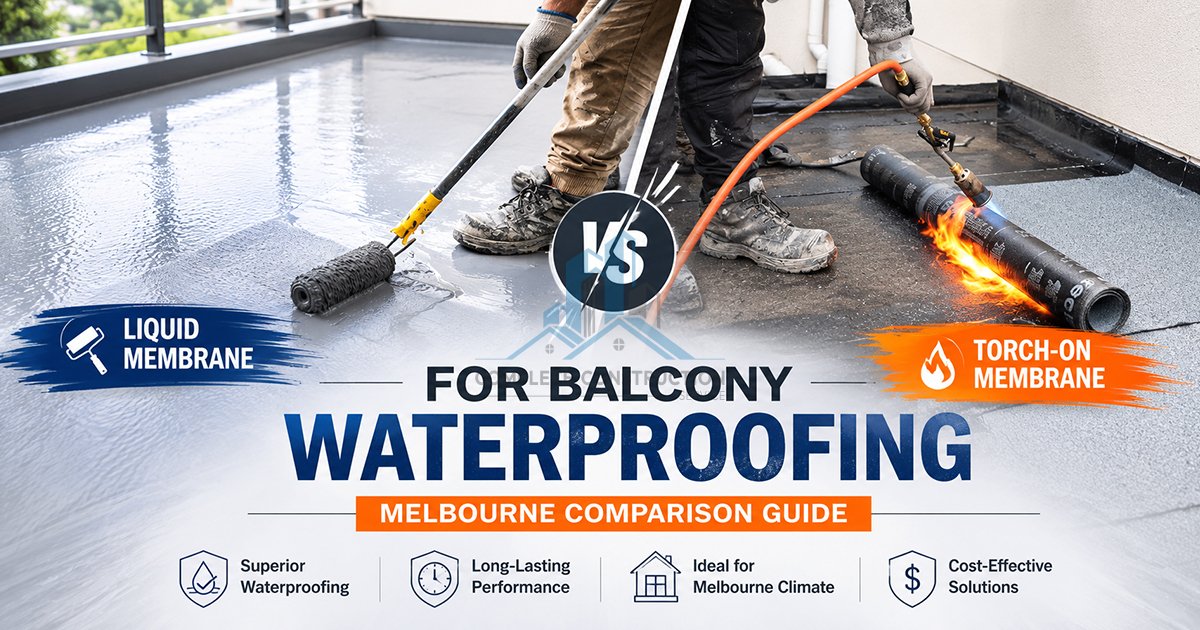
Torch-On Membrane vs Liquid Membrane for Balcony Waterproofing: Melbourne Comparison Guide
Melbourne’s notorious four seasons in one day climate places extraordinary stress on residential and commercial buildings. Among all architectural elements, external balconies are arguably the most vulnerable to structural damage. Constant shifts between freezing winter mornings and scorching summer afternoons cause building materials to expand and contract continually. This thermal cycling puts immense structural pressure on the waterproofing layer hidden beneath the tiled surface.
When a balcony begins to leak, it is rarely just a cosmetic issue or a problem with cracked grout lines. In most cases, the underlying waterproofing membrane system has fractured, degraded, or failed. Selecting the correct replacement system is the most critical decision a property owner, strata manager, or builder can make to protect the building’s asset value.
In the Australian construction and remedial industry, two primary systems dominate external waterproofing specifications: Torch-On Sheet Membranes and Liquid-Applied Waterproofing Membranes.
Choosing the right option requires understanding how these systems handle structural movement, their compatibility with different substrates, installation risks, long-term durability, and compliance with the stringent requirements of Australian building standards. This comprehensive guide provides an objective, expert comparison of torch-on and liquid membranes tailored specifically for Melbourne’s unique environmental conditions.
Quick Reference Summary: Sheet vs. Liquid Waterproofing
| Feature / Metric | Torch-On Sheet Membrane (APP/SBS Bitumen) |
Liquid-Applied Membrane (Polyurethane / Polyurea) |
| Material Composition | Prefabricated bitumen rolls reinforced with polyester or fibreglass. | Fluid compounds that cure into a seamless elastomeric layer. |
| Seams and Joints | Multiple seams overlapped and fused using an open-flame torch. | 100% seamless; monolithic application across the entire floor. |
| Application Thickness | Highly consistent factory-controlled thickness (typically 3mm to 4mm+). | Dependent on installer precision, substrate profile, and coat numbers. |
| Flexibility & Movement | Moderate to high (dependent on SBS vs. APP formulation). | Extremely high; up to 400%+ elongation capacity for high-tier liquids. |
| Cure Time & Weather Risk | Instant waterproofing once cooled; low risk from immediate rain. | Requires multi-hour curing between coats; highly sensitive to rain during application. |
| Complex Detailing | Labor-intensive; requires intricate cutting and heating around drains and corners. | Self-terminating and easily fluid-applied around complex penetrations. |
| Installation Hazard | Fire risk due to the open-flame torching process on-site. | Odour/VOC considerations; chemical handling precautions required. |
| General Lifespan | 15 to 25+ years when properly installed and protected from UV. | 10 to 20+ years depending on chemical formulation and UV stability. |
Understanding the Fundamentals: What Are These Systems?
To make an informed choice for a sheet membrane vs liquid membrane balcony Melbourne project, one must first understand what these materials are and how they operate structurally.
Torch-On Sheet Membranes (Bituminous Systems)
Torch-on membranes are prefabricated rolls of waterproofing material manufactured in a controlled factory environment. This ensures that the thickness of the sheet is perfectly uniform across the entire roll, usually ranging between 3mm and 5mm. The sheets are composed of bitumen (asphalt) that has been chemically modified to alter its physical properties, reinforced with a core of tough polyester or fibreglass matting.
During installation, a specialized gas torch liquefies the underside of the sheet as it is unrolled across the balcony floor. This molten bitumen fuses directly to a compatible substrate membrane balcony surface and bonds tightly with the overlapping edges of adjacent sheets. There are two primary categories used in Australian construction:
- APP Bitumen (Atactic Polypropylene): Modified with plastic polymers, APP bitumen raises the melting point of the sheet and provides excellent resistance to UV radiation and high summer heat. It behaves more like a tough, rigid plastic compound.
- SBS Modified Bitumen (Styrene-Butadiene-Styrene): Modified with synthetic rubber polymers, SBS modified bitumen retains exceptional elasticity and flexibility at much lower temperatures. This allows the sheet to stretch and retain its memory without cracking when the underlying building moves.
Another variation sometimes considered in remedial work is the self-adhesive membrane balcony repair sheet, which relies on a pressure-sensitive sticky backing rather than an open flame, though it generally offers less structural thickness than traditional torch-on options.
Liquid-Applied Waterproofing Membranes
Liquid waterproofing involves the application of a liquid-state chemical compound directly onto the prepared balcony substrate. It can be applied using rollers, brushes, or heavy-duty airless spray equipment. As the fluid cures, it undergoes a chemical reaction or evaporation process to form a completely seamless, continuous, rubber-like elastomeric barrier.
The standout feature of a balcony waterproofing membrane system Melbourne utilizing liquids is the total absence of laps, seams, or joins. The liquid conforms perfectly to whatever shape the balcony takes. Liquid membranes are available in several chemical families:
- Flexible Polyurethane Membrane Balcony Systems: Polyurethanes offer a superb balance of high tensile strength, excellent substrate adhesion, and high elasticity. They can accommodate substantial structural shifting.
- Acrylic and Polymer-Modified Cementitious Liquids: Often used directly beneath tile adhesives due to excellent chemical compatibility, though generally offering lower elasticity than high-end polyurethanes.
- Polyurea and Hybrid Systems: Advanced fast-curing coatings that provide rapid return-to-service times and high durability, though requiring specialized plural-component application gear.
What Are the Differences Between Sheet and Liquid Membranes?
The debate over torch-on membrane vs liquid waterproofing balcony installations comes down to several fundamental differences in application, structure, and physical performance.
Seams vs. Monolithic Coatings
The most evident distinction lies in the seams. A torch-on system requires overlapping rolls by a minimum of 75mm to 100mm at the edges. Every single seam represents a potential human-error variable. If a technician fails to achieve the correct temperature with the torch along even a few centimetres of a lap, water under hydrostatic pressure will eventually exploit that weakness. Conversely, a liquid membrane cures into a single, monolithic sheet. There are no seams to fail. This makes liquid highly effective for complex, tight balconies with multiple corners, structural posts, and pipes penetrating the floor.
Thickness Control
With a sheet membrane, thickness is guaranteed by factory manufacturing. If you purchase a 4mm APP bitumen sheet, you know the entire field of the balcony has a 4mm barrier, regardless of minor installer inconsistencies. With liquid systems, achieving the correct dry film thickness (DFT) depends entirely on the installer’s skill, the roughness of the substrate, and the strict application of the correct volume of material per square metre across multiple coats. If a liquid is rolled too thin, its waterproofing efficacy and lifespan drop sharply.
Application Hazards and Environmental Sensitivity
Torch-on membranes require open flames on-site. In tight domestic spaces or timber-framed apartment blocks, this carries an inherent fire hazard that requires strict hot-work permits and safety protocols. However, torch-on sheets are relatively forgiving of immediate weather conditions once laid; as soon as the bitumen cools, it is completely waterproof. Liquid membranes pose no fire risk but are highly vulnerable to the elements during application. If unexpected rain hits an uncured liquid polyurethane membrane, the water will ruin the chemical cross-linking, causing foaming, pinholes, and total system failure. Liquids also require a perfectly dry, fully cured concrete or screed substrate to prevent moisture entrapment, which causes the membrane to blister and delaminate later.
The Role of Australian Standard AS 4654.2 in Balcony Waterproofing
In Australia, the design and installation of waterproofing for external above-ground structures—such as balconies, roofs, and planters—are strictly governed by the Australian Standard AS 4654.2 (Waterproofing membranes for external above-ground use – Design and installation). Understanding this standard is vital for any property owner, as non-compliant installations are among the leading causes of building disputes and insurance rejections across Victoria.
Key Mandates of AS 4654.2
- Termination Heights (Upstands): The membrane cannot simply stop at the floor level. AS 4654.2 dictates that the waterproofing must extend vertically up adjacent walls to a minimum height above the finished floor level (usually 150mm, though this can vary depending on wind classification and continuous flashing configurations). This prevents rising dampness and wind-driven water from getting behind the barrier.
- Substrate Falls (Drainage): Water must never be allowed to pool continuously on top of a waterproofing membrane or a finished tiled surface. The standard mandates that the substrate must be sloped toward the drainage outlets. A minimum fall of 1:100 (10mm of drop for every 1 metre of length) is standard practice to ensure positive drainage.
- Fillets and Bond Breakers: At all transition points where a horizontal floor meets a vertical wall, structural movement concentrates stress. AS 4654.2 requires the installation of a bond breaker or fillet. For liquid membranes, this ensures the material can stretch independently across the joint rather than tearing. For sheet membranes, a triangular fillet prevents the rigid sheet from being bent at a sharp 90-degree angle, which would fracture the bitumen core.
- Overflow Provision: Balconies must feature secondary overflow measures (like a scupper through a parapet wall) so that if the main floor waste becomes blocked by leaves or debris, water cannot rise high enough to overtop the internal door sill and flood the dwelling.
Which Membrane Performs Best During Structural Movement and Thermal Expansion?
The Winner: High-Elasticity Liquid Polyurethane
When considering which membrane performs best where structural movement or thermal expansion occurs, a high-tier flexible polyurethane membrane balcony system generally outperforms sheet membranes. Buildings are dynamic structures. Wooden joists warp and flex as moisture levels change, concrete slabs sag and settle over time, and modern multi-storey buildings sway slightly in high winds. Furthermore, external balconies endure extreme thermal expansion; a concrete slab can reach over 50°C under direct summer sun and drop to near 0°C on a winter night.
To survive this movement without tearing, a membrane requires high elongation capacity and structural memory. High-quality liquid polyurethane membranes can stretch to over 400% of their original size before breaking, allowing them to bridge hairline structural cracks that open up in the concrete slab below. Because the system is fully bonded to the substrate and contains no seams, structural stresses are distributed evenly across the entire expanse of the membrane.
Torch-on sheet membranes can handle movement, but they do so differently. An SBS modified bitumen sheet features excellent rubberized elasticity, but because the sheet is thick and rigid, it requires the installer to purposefully detail expansion loops or control joints over known movement lines. If a building undergoes sudden or severe localized shifting directly beneath a sheet lap, the mechanical shear stress concentrates heavily on the fused seam. If the seam hasn’t been executed perfectly, it can delaminate or split. Therefore, for balconies prone to significant multi-directional movement, a seamless, highly flexible elastomeric liquid system is typically preferred by engineers.
Can Liquid Membrane Be Applied Directly Over Existing Tiles?
The Short Answer: It is highly discouraged for long-term reliability.
While it is technically possible to source specialized primers that allow certain liquid membranes to adhere to vitrified porcelain or ceramic tiles, doing so is considered a short-term band-aid rather than a permanent structural repair. There are several critical engineering reasons why applying a liquid membrane over tiles fails over time:
- Trapped Moisture and Blistering: If a balcony is leaking, the porous bedding screed beneath the existing tiles is already saturated with water. If you seal the top with a new liquid membrane, that moisture becomes permanently trapped. When the summer sun hits the balcony, the trapped water heats up, turns into water vapour, expands exponentially, and exerts immense upward pressure. This creates large blisters in the new liquid membrane, rapidly causing it to crack, peel, and delaminate.
- Unstable Substrate: Tiles are only as stable as the adhesive underneath them. If water has already damaged the old tile bed, the tiles may be loose, hollow, or “drummy.” Applying a flexible membrane over a moving, unstable substrate means the membrane will quickly fatigue and crack along the tile grout lines.
- Height and Drainage Profiles: Adding a layer of waterproofing plus a whole new layer of tiles or finishes over an existing tiled floor raises the absolute height of the balcony floor. This frequently breaches the mandatory door-sill clearance heights required by AS 4654.2, allowing rain to wash straight over the track and into your living room.
For a balcony leak repair to stand the test of time, the old, water-damaged tiles, adhesive, and failed screed must be stripped back entirely to expose the base structural slab. Only then can a clean, stable, and durable new membrane system be properly applied.
Which System Lasts Longer? General Lifespan & UV Resistance
When choosing the best waterproofing membrane for balcony Melbourne conditions, long-term durability is vital. Property owners want a system that will protect their structure for decades.
Torch-On Lifespan
In general industry practice, a premium, multi-layer torch-on bituminous system offers an exceptional lifespan, often lasting between 15 and 25+ years. The thick profile of the sheets (often layered to achieve 6mm to 8mm of total thickness in multi-ply applications) provides a heavy-duty physical shield that is incredibly resilient to structural wear. Because the thickness is factory-set, there are no thin spots prone to premature degradation. However, its ultimate lifespan is bound to the structural integrity of its seams and flashings.
Liquid Membrane Lifespan
A professionally applied poly-coat liquid polyurethane membrane system typically yields a reliable lifespan of 10 to 20 years. Because it forms a single, continuous bond with the substrate, it cannot be bypassed by water tracking beneath it if a localized puncture occurs. However, because liquid membranes are thinner than sheet systems (typically curing to a dry film thickness of 1.2mm to 2.0mm), they are more sensitive to mechanical damage during subsequent construction stages, such as when tilers are laying screed or dragging tools across the floor.
The Impact of UV Radiation
External balconies in Australia are subjected to intense ultraviolet (UV) light. UV radiation breaks down the polymer chains in many materials, causing them to become brittle, crack, and chalk over time.
- Liquid Membranes: Many liquid polyurethanes are sensitive to direct UV exposure. If left completely uncovered, they will degrade within a few years. Therefore, most liquid systems must be protected by a top layer of tiles, a paving system, or treated with a specific aliphatic, UV resistant waterproofing membrane Melbourne topcoat if they are to be left exposed to the elements.
- Torch-On Membranes: APP-modified bitumen sheets possess excellent inherent resistance to UV rays due to their plastic modification. Furthermore, torch-on sheets designed for exposed installations are manufactured with a factory-applied layer of mineral slate granules on the surface. These mineral granules completely shield the underlying bitumen from UV damage, making them highly durable for exposed, untiled roofs and balconies.
Sheet vs. Liquid Waterproof Balcony Cost Comparison
Evaluating a sheet vs liquid waterproof balcony cost comparison requires looking past the initial invoice for materials and analyzing the total project cost, which includes labor, preparation, and long-term maintenance.
Initial Material and Installation Costs
- Liquid Membranes: Generally have a lower material and labor cost for straightforward, small-to-medium balconies. The application is fast, requiring fewer specialized tools beyond high-quality rollers or sprayers. It is often the more cost-effective option for highly detailed or strangely shaped spaces because it eliminates the massive material wastage that occurs when cutting and fitting rigid sheet rolls into tight corners.
- Torch-On Membranes: Usually carry a higher upfront installation cost. The rolls themselves are heavy and expensive to transport, and the process is highly labor-intensive. Technicians must slowly unroll, heat, and press every square metre, paying meticulous attention to overlapping laps. Additionally, the requirement for insurance coverage regarding open flames and hot-work safety management can elevate the initial contractor cost.
Substrate Preparation Expenses
Liquid membranes demand an absolute pristine substrate. The concrete must be mechanically ground, completely free of dust, oils, or old coatings, and must have a moisture content below a strict threshold (usually 4-5%). Achieving this clean state often requires expensive surface grinding and the application of specialized moisture-barrier epoxy primers. Torch-on systems, while still requiring a structurally sound and clean surface, are significantly more forgiving of minor surface roughness, small pits, or slightly damp concrete, which can reduce the initial preparation bills.
Total Value Lifecycle
While a liquid system might save money during the initial build or renovation phase, if the installer skimps on the thickness or if unexpected rain compromises the cure, the system could fail within a few years, resulting in a full retiling bill. A properly installed torch-on system has a higher barrier to entry regarding cost but offers highly predictable structural safety due to its heavy-duty thickness.
Advantages and Disadvantages: A Comprehensive Breakdown
Torch-On Sheet Membranes
- Guaranteed Thickness: Factory-made rolls ensure zero thin spots across the entire balcony floor.
- Immediate Weather Resistance: Becomes completely waterproof as soon as the molten bitumen cools; no multi-day chemical curing windows required.
- Excellent Substrate Tolerance: Can bridge minor structural imperfections and is less sensitive to minor residual substrate moisture than liquids.
- High Structural Strength: The thick bitumen layer reinforced with polyester mats offers excellent puncture resistance against mechanical damage.
- The Vulnerability of Seams: Relies entirely on the flawless execution of multiple overlapped joins. A single gap can cause a major leak.
- Fire Hazard: Requires an open gas flame torch on-site, introducing safety risks in timber-framed residential properties.
- Difficult Complex Detailing: Intricate architectural layouts, close-set pipe penetrations, and narrow balustrade posts are highly difficult to wrap cleanly with thick sheets, increasing the risk of installation defects.
Liquid Waterproofing Membranes
- 100% Seamless Structure: Eliminates the risk of seam delamination, creating a single continuous barrier across the balcony.
- Superior Elasticity: High-grade polyurethanes offer remarkable elongation, perfectly absorbing dynamic building movement and thermal expansion.
- Flawless Detailing: Fluids flow easily around complex corners, square drainage wastes, and wall junctions, self-terminating cleanly.
- Excellent Adhesion: Bonds completely across the entire surface of concrete, screeds, and compressed fibre-cement sheets, preventing water from tracking horizontally beneath the membrane if a puncture occurs.
- Thickness Installer Dependency: Risk of thin spots if the contractor does not apply the material evenly or skips coats.
- High Climate Sensitivity: Cannot be applied on wet substrates or during rain; vulnerable to dew, humidity, and temperature fluctuations during its long curing window.
- Risk of Pinholes: If the underlying concrete outgasses (releases air trapped in its pores) while the liquid is curing, small pinholes can form, compromising the layer.
How to Choose Between Torch-On and Liquid Membranes for Leaking Balconies
Choose Torch-On Membranes If:
- The Balcony is Large and Rectangular: Large, open commercial balconies or flat concrete roof-decks allow sheet membranes to be rolled out efficiently with minimal cutting and waste.
- The Substrate is Variable: If the concrete slab is older, rough, or difficult to dry out completely, torch-on bitumen handles these imperfections well.
- Fast Turnaround is Needed Before Rain: If you are working in a highly unpredictable weather window, torch-on is waterproof immediately upon cooling, protecting the rooms below without waiting days for a coating to cure.
Choose Liquid Membranes If:
- The Layout is Intricate or Confined: If your balcony features multiple structural columns, downpipe penetrations, step-downs, or geometric angles, a liquid system will seal these areas seamlessly where sheets fail.
- The Structure Moves Constantly: For lightweight timber-framed townhouses or high-density apartment blocks subjected to thermal movement or wind sway, the high elasticity of a flexible polyurethane membrane is ideal.
- You are Laying High-End Tiling Directly Over the System: Modern liquid membranes offer excellent direct chemical bonding with high-quality polymer-modified tile adhesives, creating a compact and highly secure tile-to-membrane build.
Signs Your Melbourne Balcony Is Already Leaking
Water is a patient enemy. By the time a leak manifests as a glaring problem, it has typically been penetrating the internal structure of your building for months. Catching a failing membrane early can save tens of thousands of dollars in structural timber or concrete reconstruction. Look out for these five common warning signs:
- Water Stains or Damp Patches on the Ceiling Below: If you notice discoloration, bubbling paint, or active dripping on the plasterboard ceiling directly underneath an upper balcony, the membrane has been completely breached. The damage is actively spreading to structural framing.
- Hollow or “Drummy” Tiles When Tapped: Walk across your balcony and tap the tiles gently with a hard object or coin. If you hear a clear, hollow sound (known in the trade as a “drummy” tile), it indicates that moisture has saturated the bedding screed and broken the chemical bond holding the tile to the floor.
- White, Chalky Deposits (Efflorescence): If you see a white, powdery residue staining your grout lines or forming crusts along the front edge of your balcony slab, you are witnessing efflorescence. This occurs when water migrates through concrete, dissolves mineral salts within the slab, and carries them to the surface where the water evaporates, leaving the salt crystal structures behind.
- Cracked or Missing Grout Around the Perimeter: Grout lines that are fracturing, crumbling, or shrinking away from the wall junctions create open doorways for rainwater. While regrouting looks clean, it cannot fix a leak if the underlying membrane is already split.
- A Persistent Musty Smell Near the Balcony Door: A damp, earthy, or musty odor inside the home near balcony doors often points to hidden mould growth flourishing within the wall cavities, beneath the floorboards, or behind the skirting boards due to continuous moisture ingress.
The Professional Remedial Repair Process
A permanent fix for a leaking balcony cannot rely on surface sealers or temporary patches. It requires an organized, step-by-step reconstruction of the entire system to ensure structural security.
Step 1: Strip Back & Full Structural Assessment – The repair process begins by carefully removing all failed tiles, old adhesive beds, and contaminated, water-saturated mortar screeds down to the bare structural foundation (the concrete slab or compressed fibre-cement sheeting). The raw substrate is thoroughly inspected for structural timber rot or concrete cracking before any new materials are laid down.
Step 2: Drainage & Structural Correction – The base is mechanically ground clean. Technicians install essential metal flashings at all critical wall junctions, door sills, and perimeter edges—the exact locations where structural leaks usually originate. Drainage channels and floor wastes are adjusted or repositioned to ensure they sit flush with the base level.
Step 3: Waterproofing Membrane Application – A premium, multi-coat waterproofing membrane system is applied across the entire balcony floor, extending vertically up the wall upstands and around door entries in compliance with termination standard layouts. The membrane layer is left to cure completely under strict environmental controls, creating an impervious, uncompromised seal.
Step 4: Screed to Correct Falls – An engineered polymer-modified mortar screed is laid precisely over the cured membrane. The screed is carefully shaped to establish positive drainage falls (minimum 1:100 slope), guaranteeing that future rainwater flows directly toward the drainage outlets rather than pooling in the center of the balcony floor.
Step 5: External-Grade Tiling and Flexible Finishes – High-quality external-grade tiles are installed using highly flexible, frost-resistant tile adhesives that can handle temperature swings. Technicians incorporate dedicated perimeter movement joints and flexible polyurethane expansion grouts to allow the finished surface to flex naturally without cracking.
Frequently Asked Questions (FAQs)
How long does a balcony leak repair take in Melbourne?
A full structural balcony remediation—involving stripping back tiles, replacing the waterproofing membrane system, pouring new screed to correct falls, and retiling—typically takes between 5 and 7 working days. This timeline accommodates the mandatory chemical curing windows required for membranes, screeds, and tile adhesives to achieve structural strength.
What is the single most common cause of balcony leaks?
While cracked grout or poor tiling is highly visible, the true root cause of almost all balcony leaks is a failed or incorrectly detailed waterproofing membrane underneath the tiles, frequently exacerbated by flat or inadequate floor falls that cause water to pool indefinitely on the balcony.
Can a balcony leak cause structural concrete cancer?
Yes. If rainwater continuously bypasses a failed membrane and saturates a concrete slab, the moisture reaches the internal steel reinforcing bars. The steel rusts, expands up to eight times its original volume, and fractures the concrete from within. This serious structural degradation is known as concrete cancer or spalling.
Conclusion & Next Steps
When confronting a leaking balcony in Melbourne, understanding the structural differences between torch-on sheet membranes and liquid-applied systems ensures you make the right choice for your building’s architecture. Sheet membranes offer rugged, factory-controlled thickness best suited for large, uniform spaces, while liquid polyurethanes provide a seamless, highly flexible barrier that adapts perfectly to complex geometries and handles thermal expansion beautifully.
Because a leaking balcony will never self-repair and will only worsen with every subsequent rainfall event, acting quickly is the best way to prevent localized damage from expanding into a catastrophic structural repair bill.
If you suspect your balcony’s waterproofing system is failing, have it professionally evaluated. A comprehensive diagnostic inspection utilizing advanced thermal imaging and moisture mapping can accurately pinpoint hidden water paths beneath your tiles, allowing for a targeted, fixed-price solution that resolves the root cause permanently.