

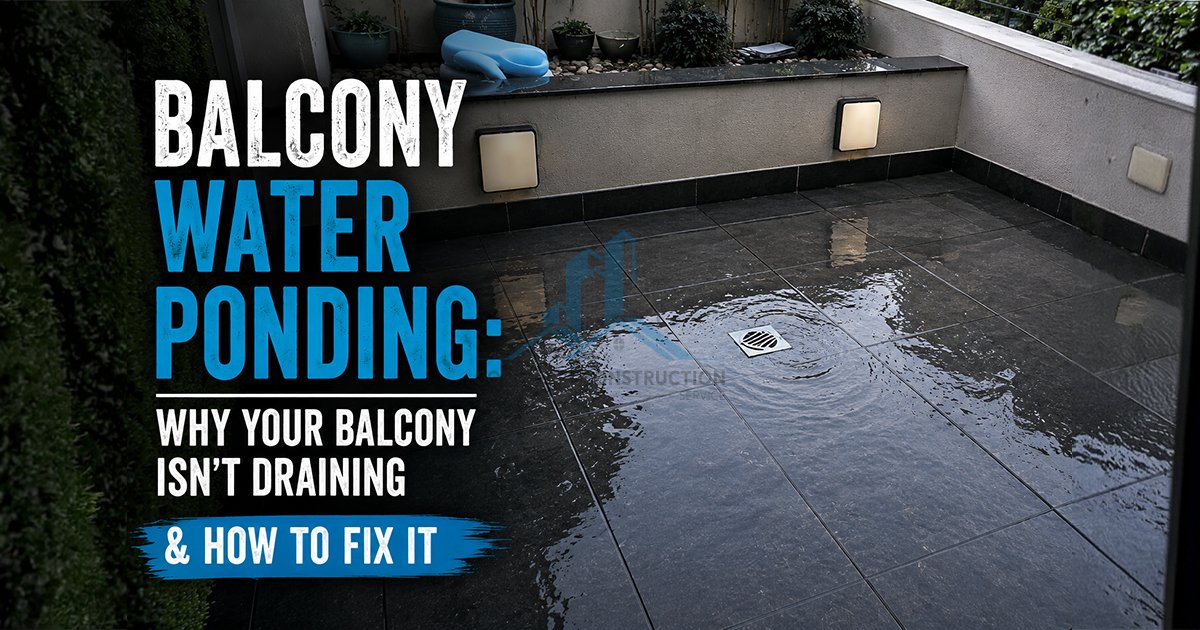
Balcony Water Ponding: Why Your Balcony Isn’t Draining & How to Fix It
If you’ve noticed water pooling on your balcony after Melbourne’s frequent rain or even just during morning dew, you’re not alone. Balcony water ponding is one of the most common — and most costly if ignored — issues affecting homeowners and apartment owners across the city.
Unlike a roof leak that announces itself immediately, water ponding can silently cause structural damage for months or even years. By the time it becomes obvious that there’s a problem, water has often worked its way into the building structure beneath, attacking concrete, corroding steel reinforcement, and breeding mould in hidden cavities.
The good news? In most cases, balcony water ponding can be fixed — and you don’t always need to replace the entire waterproofing system. But first, you need to understand what’s causing the problem.
What is Balcony Water Ponding?
Balcony water ponding describes the accumulation of standing water that persists on your balcony surface for hours or days after rain, rather than draining freely toward the drainage outlet. In Australia’s climate, balconies are engineered to shed water quickly — but when they don’t, the consequences cascade.
Water that should flow away in minutes instead sits, pressing against the waterproofing membrane, pooling in low spots, and forcing its way through tiny cracks and deteriorating seals. Over time, this prolonged contact breaks down even quality waterproofing systems, especially in Melbourne’s harsh cycle of temperature swings and heavy downpours.
Why Do Melbourne Balconies Develop Standing Water?
Standing water doesn’t just appear by accident. Every balcony with a ponding problem has at least one — and often several — underlying issues that prevent water from draining properly. Understanding these causes is essential to identifying the right repair solution for your balcony.
1. Incorrect Drainage Falls and Gradients
The most common cause of balcony water ponding is insufficient drainage fall — a failure to engineer the balcony surface to slope toward the drainage outlet. Australian Standard AS 4654 (“Balcony Drainage and Fall”) specifies minimum fall requirements to ensure water moves efficiently off the balcony surface.
AS 4654 recommends a minimum fall of 1 in 80 (a 1.25% gradient) to clear debris and ensure positive drainage. In practice, many older balconies were built with falls of 1 in 100 or even flatter — barely noticeable to the eye, but catastrophic for water management. When a balcony is laid level or nearly level, water simply has nowhere to go. It pools in the lowest spot, typically near the centre of the balcony or beside the perimeter wall.
Even a seemingly small issue — a screed that’s settled 5–10mm in one section, or a floor waste that’s been installed at the wrong level — can destroy the drainage gradient and turn a functional balcony into a water trap.
2. Clogged and Blocked Balcony Drains
Even if your balcony was designed with correct falls, a blocked or clogged floor waste or drain outlet means water cannot escape, no matter how steep the gradient.
Over time, debris accumulates in balcony drains: leaves, dirt, tile fragments, grout particles, paint chips, and other building materials. In Melbourne’s older buildings, corroded pipes can also collect sediment and rust particles that restrict flow. If the drain pipe beneath the balcony has suffered impact damage or has shifted due to building settlement, it may also be partially blocked or kinked.
A clogged drain can be detected during a professional inspection by running water across the balcony surface and observing whether it flows freely toward the outlet, or if the outlet itself is visibly blocked. In many cases, clearing the drain and associated pipework is all that’s needed to restore proper drainage — but the blockage must be cleared completely, not just partially displaced.
3. Slab Settlement and Building Movement
Building structures naturally settle over time, especially in the first 5–10 years after construction. Differential settlement — where one part of a balcony slab drops more than another — can destroy even a perfectly engineered drainage gradient.
This is particularly common in Melbourne apartment buildings built on clay soils or in areas prone to soil shrinkage. The concrete slab may shift by 10–50mm, creating a new low spot where water pools, or tilting the balcony so that water now flows back toward the building instead of away from it.
Slab settlement can be identified through visual inspection (looking for sagging or tilting), moisture mapping to identify where water is pooling, and thermal imaging to detect areas where water has been trapped. Once settlement has occurred, the only permanent fix is to re-screed the balcony to restore correct falls — a process that must be done carefully to avoid cracking the underlying membrane.
4. Waterproofing Membrane Failure and Degradation
The membrane beneath your balcony tiles is the critical layer preventing water from penetrating deeper into the structure. When this membrane fails — due to age, UV exposure, movement, or poor initial installation — water doesn’t just pool on the surface; it seeps through the membrane and into the substrate below.
Melbourne’s climate is particularly harsh on waterproofing membranes. Temperature swings from hot summers to cold winters cause the membrane to expand and contract, eventually leading to small cracks. If the original membrane wasn’t flexible enough or wasn’t applied with proper coverage (including all upstands and edges), failure is almost inevitable.
Identifying membrane failure requires professional assessment. Thermal imaging cameras can often detect moisture beneath the surface of tiles, and moisture meters provide precise readings of the substrate’s hydration levels. Sometimes the only way to be certain is to lift a small section of tiles and inspect the membrane visually.
5. Failed Perimeter Flashings and Movement Joints
The edges and corners of your balcony — particularly where the balcony meets the building wall — are the most vulnerable points for water entry. These junctions need metal flashings and flexible sealants to direct water away and accommodate building movement.
Over time, grout and sealants crack and fail, creating direct pathways for water to enter the wall cavity and building structure. Once water gets behind the tiles at the perimeter, it can travel horizontally along the top of the structural frame, affecting areas several metres away from where the water initially entered.
This is why regrouting alone never fixes a leaking balcony. If the perimeter sealant and flashings have failed, water will find a way in regardless of how fresh the grout looks.
6. Overflow Outlets and Secondary Drainage Failure
Many balconies are equipped with secondary (overflow) outlets designed to cope with heavy rainfall when the primary drain is overwhelmed. These overflow outlets are often positioned at the perimeter edge and are meant to discharge water away from the building wall.
If the overflow outlet is missing, blocked, or has been installed incorrectly — for example, discharging water back toward the building instead of away from it — water accumulation becomes inevitable during heavy rain events.
A complete balcony drainage assessment should include verification that both primary and secondary drainage systems are functional, unobstructed, and correctly positioned.
The Real Cost of Ignoring Balcony Water Ponding
Water ponding might seem like a cosmetic issue, but it causes structural damage that compounds rapidly.
Structural rot in timber joists and bearers, concrete cancer caused by corrosion of steel reinforcement, internal damage to ceilings and plasterboard below the balcony, mould growth in cavities, and odour problems in the room below are all inevitable consequences of prolonged water exposure. What starts as a small cost to fix the drainage can become a five or six-figure remediation project if water is allowed to saturate the structure for months.
5 Signs Your Melbourne Balcony Has Water Ponding Issues
By the time you notice an obvious problem, water has often been pooling for quite some time. Here’s what to look for before it gets serious:
- Visible Standing Water After Rain: Water remains on the balcony for several hours after rain has stopped, rather than draining within minutes.
- Efflorescence (White Mineral Deposits): Chalky, white staining on tiles or at the balcony edge indicates water is moving through the concrete and carrying mineral salts outward.
- Discolouration or Water Marks: Staining on tiles, dark patches, or visible water marks that don’t fade indicate repeated water exposure and poor drainage.
- Hollow or Drummy Tiles: When you tap tiles and they sound hollow rather than solid, it usually means the adhesive underneath has weakened due to water penetration.
- Water Stains or Dampness Below the Balcony: This is a red flag. Staining on the ceiling, walls, or floor of the room below your balcony indicates water has already penetrated the structure and the problem requires urgent repair.
Can You Fix Water Ponding Without Replacing the Entire Waterproofing System?
This is the question homeowners ask most often, and the answer depends on the root cause.
In many cases, a balcony can be restored to full function without necessarily replacing the entire waterproofing membrane:
✓ If the problem is a blocked drain: Clear the drainage system thoroughly. If this restores proper water flow and there’s no evidence of membrane damage, the fix may be limited to drainage clearing and repair of any perimeter sealants.
✓ If the problem is incorrect falls: The balcony can be re-screeded to restore correct gradients. This requires tiles to be removed and replaced, and a new membrane application, but doesn’t necessarily mean the entire original membrane system failed irreparably.
✓ If the problem is failed perimeter sealants and flashings: These can often be repaired or replaced while keeping the main membrane intact, provided the underlying membrane hasn’t been severely compromised.
However, in some situations, full system replacement is the only lasting solution:
✗ If the membrane has widespread cracking or blistering, full replacement is necessary. Patching isolated areas of a degraded membrane rarely holds.
✗ If water is actively penetrating through the membrane and causing structural damage, partial repair is a false economy. A full rebuild ensures the problem won’t recur.
✗ If slab settlement has been severe (more than 10–15mm), re-screeding alone may not be sufficient if the underlying membrane has already begun to crack or fail.
The only way to know which approach is right for your balcony is to have a thorough professional inspection conducted before any repair estimate is provided. This is why Complete Construction Service uses thermal imaging, moisture mapping, and detailed diagnostic assessment before recommending a repair strategy — to ensure the solution matches the actual problem, not just the obvious symptoms.
Understanding AS 4654: Australian Standards for Balcony Drainage
AS 4654 is the Australian Standard that sets minimum requirements for balcony design, drainage, and waterproofing. Understanding what it requires helps you assess whether your balcony meets current best practices.
Key AS 4654 Requirements:
- Minimum fall of 1 in 80 (1.25%) toward the drainage outlet • All balconies must have at least one primary drainage point • Overflow outlets must be provided where secondary drainage is needed • Perimeter flashings must prevent water entry at wall junctions • Waterproofing membranes must be flexible and accommodate building movement • Movement joints must be installed where different materials meet
If your balcony was built before AS 4654 was established or if it’s an older building, it may not meet current standards. This is particularly common in Melbourne buildings constructed before 2000. Upgrading to meet current standards during a repair is often recommended to prevent re-occurrence of drainage problems.
How to Inspect Your Balcony for Water Ponding Issues
You can perform a basic visual inspection of your balcony without professional equipment. Here’s what to check:
Step 1: Visual Assessment
Stand back and look at the overall shape of your balcony. Does it appear to slope toward the drain, or does it look level or even slope away? Look for any visible low spots where water would naturally collect. Check whether tiles are cracked or lifting, and inspect the grout line around the perimeter wall for gaps or deterioration.
Step 2: Water Test (After Light Rain)
After a light rain (not a heavy storm), go outside and observe where water is pooling and how long it takes to drain. Water should flow toward the drain outlet within seconds. If it’s still sitting 10–15 minutes after rain has stopped, you have a drainage problem.
Step 3: Check the Drain Outlet
Inspect the floor waste or drain outlet. Is it blocked with debris, leaves, or sediment? Can you see into it freely, or is it partially obstructed? If possible, pour a bucket of water down the drain and listen to ensure it flows freely.
Step 4: Look Below the Balcony
Check the ceiling of the room below the balcony for water stains, discolouration, or signs of dampness. Look at the wall where the balcony meets the building for any visible moisture, mould, or salt staining. These are red flags indicating water penetration.
When in doubt, contact a professional. A thermal imaging inspection will provide definitive answers about where water is actually traveling and whether your balcony’s membrane and structure have been compromised.
Preventative Maintenance to Avoid Water Ponding
Once a balcony is repaired and properly waterproofed, ongoing maintenance helps prevent recurrence of drainage problems:
- Clear the drain outlet regularly (monthly during autumn and after storms) to prevent debris accumulation • Inspect grout and sealants annually; re-grout or reseal as needed • Look for cracked or lifting tiles and repair them promptly • After heavy rain, check that water drains fully within minutes • Avoid sealing or painting over drainage outlets • Don’t position pot plants or debris where they might block water flow
Most importantly, address small drainage issues immediately. A drain that’s 50% blocked today can be fully blocked in a few months if left unattended.
When Professional Intervention is Required
Contact a licensed waterproofing specialist if you observe any of the following:
- Water staining or dampness on the ceiling below your balcony • Persistent standing water that doesn’t drain within 15 minutes of rain stopping • Hollow or drummy tiles over a large area • Visible cracks in tiles or grout, especially around perimeter edges • Musty or damp smell near the balcony • White efflorescence staining that keeps recurring despite cleaning • Tiles that are visibly tilted or sloping in the wrong direction • Any visible structural damage, concrete spalling, or rust staining
A professional inspection using thermal imaging and moisture mapping will identify the exact cause of the problem and determine whether a partial repair or full system replacement is needed. This diagnostic approach saves money in the long run because it ensures the repair targets the actual problem, not just the symptoms.
Frequently Asked Questions About Balcony Water Ponding
Q: How much does it cost to fix balcony water ponding in Melbourne?
A: Cost varies depending on the balcony size, the extent of the damage, and which components need repair. A drain clearing might cost $500–$1,200. Re-screeding with new tiles typically ranges from $3,000–$8,000 depending on size. Full waterproofing membrane replacement usually requires significant investment, but the exact cost depends on what the diagnostic inspection reveals. That’s why professional assessment is crucial — it provides a fixed-price quote before any work begins.
Q: How long does balcony water ponding repair take?
A: A diagnostic inspection typically takes 2–3 hours. Repair timeline depends on the work required. A drain clearing might be completed in a single day. Membrane replacement and re-tiling usually takes 5–7 working days.
Q: Will my balcony definitely need to have tiles removed for repair?
A: In most cases, yes. To access and properly repair the waterproofing membrane beneath tiles, or to re-screed the balcony to correct falls, tiles must be removed. Attempting to repair without removing tiles usually results in a temporary fix that re-leaks within months. A proper repair is more costly upfront but prevents repeat failures.
Q: What warranty do I get on the repair?
A: Complete Construction Service backs all balcony waterproofing work with a written 10-year waterproofing warranty. If the waterproofed area leaks within 10 years, we return and fix it at no cost. This warranty is only provided when the work is carried out to full specification using quality membranes and proper methodology — which is why diagnostic assessment and fixed-price quoting upfront are so important.
Q: Can a balcony with poor falls be fixed without being re-screeded?
A: Not permanently. Waterproof sealers applied over the top of tiles might temporarily slow water ponding, but they don’t fix the underlying drainage issue. Without correct falls, water will eventually find its way through, and the problem recurs. Correct falls must be engineered into the screed layer beneath the tiles.
Q: Is water ponding covered by building insurance or body corporate?
A: This depends on your specific insurance policy and your building’s circumstances. Some policies cover water damage caused by building defects; others don’t. For apartment buildings and strata properties, responsibility often lies with the body corporate. A detailed inspection report with thermal imaging and photographic evidence is helpful for insurance claims. We provide comprehensive documentation with every assessment.
Take Action Before Balcony Water Ponding Becomes Structural Damage
Balcony water ponding is never just a cosmetic problem. Water that doesn’t drain properly will eventually penetrate the membrane, damage the structure beneath, and create expensive remediation problems.
The good news is that most water ponding issues can be fixed once the root cause is identified. Whether it’s a blocked drain, incorrect falls, failed perimeter sealants, or membrane degradation, the solution depends entirely on getting an accurate diagnosis first.
Complete Construction Service has repaired hundreds of Melbourne balconies, from single townhouses to large apartment buildings. Our diagnostic approach using thermal imaging and moisture mapping means we identify the actual problem — not guesswork. Once we know what’s wrong, we provide a fixed-price quote and complete the repair using quality materials and proven methodology.
Every waterproofing job is backed by a written 10-year warranty, because we’re confident in our work and we stand behind it.
Don’t wait until water stains appear on the ceiling below your balcony. If you’ve noticed standing water after rain, discharge from the wrong outlet, or any of the warning signs mentioned in this article, get a professional inspection today.
Get a Professional Balcony Assessment Today
Complete Construction Service provides comprehensive balcony inspections across all Melbourne suburbs, from Cranbourne and Pakenham to Glen Waverley, Dandenong, and beyond.
Our inspection includes:
✓ Thermal imaging to detect hidden moisture ✓ Electronic moisture mapping to measure saturation levels ✓ Detailed photographic documentation ✓ Professional diagnosis of the cause ✓ Fixed-price quote with no hidden variations
Contact us today for a free quote and professional site visit.
Phone: 1300 221 476 (24/7 support) Email: office@completeconstructionservice.com.au Website: www.completeconstructionservice.com.au
Or request a site visit online through our contact form.
About Complete Construction Service
Complete Construction Service is a Melbourne-based waterproofing, tiling, and construction specialist with over 30 licensed tradespeople. We specialise in balcony leak repair, waterproofing, rendering, and renovation work across residential and strata properties. Every project is backed by our written 10-year waterproofing warranty and completed with fixed-price transparency no surprises, no hidden variations.
We serve Melbourne’s inner suburbs, growth corridors, and outer suburbs. Whether your balcony needs a simple drain clearing or a complete waterproofing system replacement, we diagnose the problem correctly and fix it right.